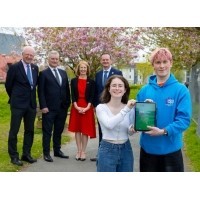


South East Technological University (SETU) has launched its inaugural Sustainability Strategy 2026-2030, marking a major milestone in its commitment to building a more resilient future by firmly embedding sustainability at the core of its teaching, research, and regional engagement.
The ambitious strategy was unveiled on Wednesday, 22 April as part of the University’s fourth annual Sustainability in the Arts Festival. The week-long festival brings together students, staff, artists and members of the wider community for a programme of exhibitions, performances and collaborative work focused on climate awareness, creativity and social responsibility.
Among the speakers at the strategy launch was former Ambassador David Donoghue, globally recognised for his role in shaping the 2030 Agenda for Sustainable Development which resulted in the United Nation’s Sustainable Development Goals.
Addressing the large crowd in attendance, Ambassador Donoghue highlighted the importance of engaging younger generations with the major issues of our time. He said, “We must encourage today’s youth to recognise the challenges facing our society and sustainability is certainly one of the more obvious global challenges we face. Universities play a key role in responding to these issues and have an important part to play in the implementation of the UN’s Sustainable Development Goals. SETU’s Sustainability Strategy acts as a fine example of what can be achieved in this regard by universities in Ireland and in Europe.”
President of SETU, Professor Veronica Campbell was honoured to welcome Ambassador Donoghue to the launch, describing it as a significant step that sets the University on a path of meaningful change and ongoing improvement.
Prof. Campbell said, “This inaugural sustainability strategy sets out a clear and ambitious shared vision for the future, reflecting SETU’s commitment to making sustainability integral to our campuses, our communities and our wider impact as a university.
“Sustainability is now being embedded across every aspect of university life at SETU - from how we teach, learn and research, to how we design, manage, and operate our campuses. Our approach is deliberately multi-layered: education informs, research generates new thinking, and our operations demonstrate the practical application of that knowledge and insight.”
SETU is committed to leading by example in sustainable social, economic, and environmental development. “Through this strategy, we intend to foster a culture of climate action, protect biodiversity, and empower our students and staff through education for sustainable development. In doing so, we will drive positive change locally, nationally, and globally,” Prof. Campbell said.
Aligned with SETU’s strategic plan, Connecting for Impact, the sustainability strategy focuses on four interconnected areas of climate, nature, education and impact, each closely aligned with the United Nations Sustainable Development Goals.
Working in partnership with students and staff, SETU will reduce the University’s carbon footprint with the ultimate aim of achieving net-zero emissions, foster a culture of climate action, and enhance campus environments to support biodiversity, wellbeing and ecological restoration.
With up to 15,000 students and staff travelling daily to SETU campuses, the strategy also highlights the need to support active travel and more integrated public transport options.
It seeks to champion green spaces, embed nature-positive practices, and establish the University as a living landscape for learning, innovation, ecological restoration, and community engagement.
The strategy was favourably welcomed by student representatives including Hannah O Sullivan, first year student rep, and Daniel Fagan, SETU Students’ Union Vice President for Education, who spoke at the event.
Strong emphasis is placed on embedding sustainable development across teaching, learning and research, with the aim of equipping graduates to navigate an increasingly complex and evolving world and to seize the opportunities created by the global transition to sustainability.
Associate Vice President for Sustainability at SETU, Dr David Ryan, who acted as MC for the event, said, “This strategy sets out an ambitious and shared vision for our future. It reflects our collective commitment and responsibility to advance our sustainable development agenda in terms of our people and communities of students, staff and those with whom we engage, our campus places, spaces, infrastructure and processes, ensuring that sustainability is an integral part of everyday university life.”
SETU also intends to deepen collaboration with regional partners, including industry and community organisations to address shared environmental and socio-economic challenges. In doing so, SETU is positioning itself not only as a participant in sustainability efforts, but as a driver of change within the region.