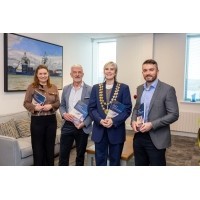


The South East of Ireland stands to secure a transformative economic uplift from offshore renewable energy development, according to a new report from the South East Energy Agency launched today (March 9th) examining the economic, business and community opportunities arising from the South Coast Designated Maritime Area Plan (SC-DMAP).
The report and launch event was funded by the four South East local authorities, and a key theme was the strategic alignment between Waterford, Wexford, Carlow and Kilkenny, who are working collectively to ensure the region is fully prepared to capture the supply chain, infrastructure and enterprise benefits associated with offshore wind.
Potential GVA Uplift
The report highlights that the development of 4.9GW of offshore wind capacity off the South Coast could generate between €1.7 billion and €2.2 billion in additional Gross Value Added (GVA) for the wider South region. Based on current regional output of approximately €19.5 billion, this represents a potential uplift of over 11% to the South East economy.
In addition to the direct economic contribution, the report estimates that up to €500 million could flow into local communities through the Community Benefit Fund mechanism over the lifetime of the projects. These funds are intended to support social infrastructure, rural and coastal resilience, and long-term community development.
Infrastructure Development
The infrastructure session of the launch event featured David Sinnott, CEO of the Port of Waterford; Lar Power, CEO of Kilkenny County Council; and Moira Walsh, Project Manager of ESB’s Tonn Nua project. Speakers highlighted the critical role of port capacity, grid readiness, coordinated spatial planning, and supporting industrial infrastructure in enabling offshore wind deployment at scale.
Offshore renewable energy also presents significant employment potential, both during construction and long-term operations and maintenance phases, and in capturing the value of co-locating large energy users and green energy industrial parks close to the sites of renewable generation.
Economic Opportunity
Economist Jim Power presented the key findings of the report, outlining the scale of economic opportunity available to the South East if the region successfully captures offshore wind supply chain activity. A high-level panel discussion followed, chaired by Jim Power, featuring representatives from South East Technological University, Enterprise Ireland, IDA and industry partnerships. Panellists discussed how offshore wind momentum can translate into long-term regional economic gain through:
- Strengthening research and innovation capacity
- Preparing local supply chains for procurement readiness
- Attracting FDI into renewable energy clusters
- Developing Green Energy Parks as a competitive regional advantage
The South East’s collaborative model, linking local authorities, enterprise agencies, the South East Technological University, and industry, was cited as a key differentiator in building investor confidence. The report emphasises that delivery of the full economic dividend will depend on coordinated regional action, timely infrastructure investment and full implementation of the SC-DMAP.
Chair of the Ireland South East Offshore Wind Partnership, Dr. David Dempsey, added: “The South East has the assets, the geography and the industrial capability to become a leading offshore renewable energy hub. With the right policy alignment and continued collaboration, the region can deliver sustainable jobs, attract investment and contribute meaningfully to Ireland’s climate and competitiveness goals.”
With offshore wind projects now moving into delivery phase, the South East is positioning itself not simply as a location where renewable energy is generated, but as a region where that energy underpins long-term economic growth.
The event concluded with a networking session that further reinforced the depth of cross-sector engagement underpinning the initiative.
Download the Report here.