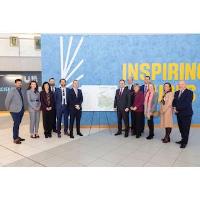


SETU Welcomes Progress on Two Significant University Developments
South East Technological University (SETU) has welcomed progress on two significant developments for the University, following a visit by Minister for Further and Higher Education, Research, Innovation and Science, James Lawless TD.
Minister Lawless announced during a site visit to Wexford that SETU and Waterford and Wexford Education and Training Board (WWETB) are to explore opportunities associated with the development of a new contemporary tertiary campus on Wexford County Council owned lands at Ballynagee, Co Wexford. Later that afternoon, the Minister confirmed that SETU’s proposal under the Technological Sector Strategic Projects Fund (TSSPF) for the first academic building at Glassworks in Waterford City is moving to the next stage of development.
Minister Lawless said: “I am really pleased to announce two landmark educational projects for Wexford and Waterford, initiatives that will strengthen the region’s tertiary education infrastructure. By investing in modern tertiary facilities and resources, these projects aim to expand opportunities for students, foster innovation, and position the region as a hub of academic excellence and economic growth.” Professor Veronica Campbell, President of SETU, said the Minister’s announcement represents “a defining moment for the University’s future development.”
As part of its Strategic Plan, SETU is committed to expanding its footprint across the South East. “Both developments, in Waterford and Wexford signal the scale of our ambition and the confidence we place in the region’s potential,” Prof. Campbell said. The announcement marks a significant milestone for the transformative Glassworks 37-acre site, 20 acres of which are owned by the University. The integrated ecosystem is being designed to strengthen collaboration between academia and enterprise.
Prof. Campbell noted that the “regional economy is increasingly driven by innovation-led industries, particularly in the biopharma, agri-food and environmental sectors, which depend on a strong talent pipeline and robust research partnerships”.
The Glassworks Campus where the 10,000m² One Health building will be situated, will position SETU as a leading provider of education and research in biopharma, agri-food and eco-innovation, working closely with partners across the South East region and beyond. The building will include modern laboratories, and advanced teaching spaces dedicated to One Health academic and research activities. Aligned with SETU’s Strategic Plan, it will also incorporate high environmental standards, including low and zero-carbon technologies, high-performance materials, biodiversity features and inclusive design principles.
Prof. Campbell acknowledged the vital support of the Higher Education Authority and the Department of Further and Higher Education, Research, Innovation and Science in enabling the project. During a site visit to lands recently acquired by Wexford County Council at Ballynagee, Minister Lawless outlined the intent for SETU and WWETB to develop a proposal for a collaborative tertiary campus on part of the site. Prof. Campbell said the announcement reflects SETU’s commitment to delivering third-level tertiary infrastructure in Wexford as part of its strategic vision.
Work on shaping the academic and development vision for SETU has been ongoing through extensive engagement with staff and stakeholders to develop a proposal that blends new activity in areas such as renewable energy, the blue economy and ancillary themes, with existing strengths in Wexford and across the wider University.
“The proposed new development at Ballynagee in Wexford will make a wider regional impact while bringing significant benefits to Wexford town and its surrounding area. It will build on SETU’s current strengths in Wexford and expand the University’s offerings into new areas. We look forward to working with WWETB to deliver tertiary education as well as supporting research and innovation activities that are relevant to Wexford and the broader region.” Prof. Campbell said.